


Author: Ivan Smajla, mag. ing. petrol.
Although a fossil fuel, natural gas remains one of the most important energy sources in the European Union, having met about a quarter of its energy needs in 2020. With the development of the European Union's green policy, it is evident that natural gas has no prospects as an energy source in the period after 2050, but until then it will have an important transitional role. The gas system in the European Union is the most developed in the world in terms of supply, market organization, distribution, transport, etc., but there is still room for further optimization of the system. The development of gas smart meters has enabled the collection of data on natural gas consumption in real time, which can then be used in a variety of ways to optimize the system. One of the most important ways is certainly to predict the future consumption of natural gas for a particular area because more accurate forecasting of consumption significantly reduces the need to balance the gas system (Smajla et al., 2021). This results in reduced financial costs for suppliers, reduced energy consumption but also fewer working hours. In addition to balancing, the data collected also provide end users with an up-to-date insight into their own consumption, which in most cases results in a reduction in natural gas consumption in order to achieve financial savings (Mogles et al., 2017). This research is based on a pilot project for the installation of gas smart meters conducted in the east of the Republic of Croatia, where several thousand gas smart meters were installed. In addition to these data, publicly available data on similar projects at the European Union level (Af Mercados Emi and ICCS-NTUA, 2015; European Commission, 2019) were used to calculate the financial viability of installing gas smart meters.
A feasibility analysis was conducted as a part of this research that took into account the different energy savings achieved using gas smart meters (savings of 1,83%, 5.,73% and 9,63%). The analysis showed that the installation project is cost-effective if energy savings of 5,73% and 9,63% are taken into account. What further improves the financial viability of such a project are the financial savings that the investor (usually the supplier) will legally achieve because the installation of gas smart meters for the first 5 years of the project is recognized as a measure to achieve energy savings. Figure 1 summarizes the operating and investment costs and benefits of installing gas smart meters.

Figure 1 Costs and achievable savings on the example of installing 100,000 gas smart meters (Smajla et al., 2022)
The research conducted a detailed review of the current literature on the topic of forecasting natural gas consumption. The review showed that modern methods for predicting natural gas consumption most often use complex methods of different variants of machine learning in order to achieve the most accurate results (Smajla et al., 2021). The literature has also shown that for the short-term consumption forecast, the most important input parameters are daily natural gas consumption and outdoor temperature. In accordance with the above and researched in the literature, a flowchart has been proposed for the development of the most accurate method for predicting natural gas consumption (Figure 2). The flowchart indicates that the previously mentioned input parameters need to be filtered and processed in order to form a quality input database. Such a database is then used in a consumption forecasting model whose results must be validated to determine the success of the forecast. If the prediction accuracy is not satisfactory, the model needs to be modified or adjusted for better accuracy.
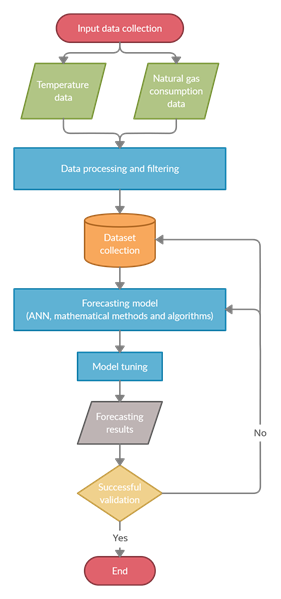
Figure 2 Proposed flowchart for defining a method for predicting short-term natural gas consumption (Smajla et al., 2021)
A review of the literature also concluded that so far the determination of the most favorable statistical distribution for the distribution of consumers in the analyzed area according to the criterion of daily consumption has not been considered. Further research will be based on determining the most favorable statistical distribution of consumers whose parameters will be correlated with the outside temperature. In this way, it will be possible to use a short-term weather forecast to determine the total natural gas consumption in the analyzed distribution area.
References:
Af Mercados Emi and Institute of Communication & Computer Systems of the National Technical University of Athens ICCS-NTUA, 2015. Study on cost benefit analysis of smart metering systems in EU member states. https://energy.ec.europa.eu/study-cost-benefit-analysis-smart-metering-systems-eu-member-states_en
European Commission (2019): Benchmarking smart metering deployment in the EU-28 - final report. https://op.europa.eu/en/publication-detail/-/publication/b397ef73-698f-11ea-b735-01aa75ed71a1/language-en
Mogles N., Walker I., Ramallo-González A.P., Lee J.H., Natarajan S., Padget J., Gabe-Thomas E., Lovett T., Ren G., Hyniewska S., O’Neill E., Hourizi R., Coley R. (2017): How smart do smart meters need to be? Build. Environ. 12, 439–450. http://dx.doi.org/10.1016/j.buildenv.2017.09.008.
Smajla I., Karasalihović Sedlar D., Vulin D., Jukić L. (2021): Influence of smart meters on the accuracy of methods for forecasting natural gas consumption. Energy Rep. 7, 8287–8297. http://dx.doi.org/10.1016/j.egyr.2021.06.014.
Smajla I., Karasalihović Sedlar D., Jukić L., Vištica N. (2022): Cost-effectiveness of installing modules for remote reading of natural gas consumption based on a pilot project. Energy Rep. 8, 5631-5639. https://doi.org/10.1016/j.egyr.2022.04.019.
Ivan Smajla, mag. ing. petrol. is a doctoral student at the Department of Petroleum and Gas Engineering and Energy at the Faculty of Mining, Geology and Petroleum Engineering, University of Zagreb.
E-portfolio Link
CROSBI Link