


Author: Katarina Žbulj, PhD
Through the process of oil and gas production, gathering, treatment and transportation, most of the process equipment and pipelines are made of carbon steel. In most cases, depending on the type of the reservoir, the production of hydrocarbons involves the production of a certain amount of brine. In addition to brine, the produced fluid may contain impurities such as sand, additives that were used during the production process (biocides, scale inhibitors, demulsifiers, etc.), but also dissolved gas, carbon dioxide (CO2) and hydrogen sulfide (H2S) which, dissolved in water (brine) cause corrosion and damage the equipment. In general, carbon steel is susceptible to corrosion. Sastri (2011) defines corrosion as the destruction of a material caused by the aggressive environment to which the material is exposed. The consequences of corrosion in the petroleum industry could affect the environment (potential cause of fluid spill) but also, due to equipment damage, and in addition to the impact on the environment, they also have a great economic impact. In systems where water is present, electrochemical corrosion will occur. Flowlines are the most sensitive part of an oil and gas transportation system. Fluid, transported in flowlines, is not yet treated, and it contains brine and impurities, such as carbon dioxide. Flowlines, gathering pipelines and waterlines are mostly made of carbon steel, and that makes them susceptible to CO2 corrosion. Some of corrosion types, that can be found in petroleum industry, can be seen in Figure 1.
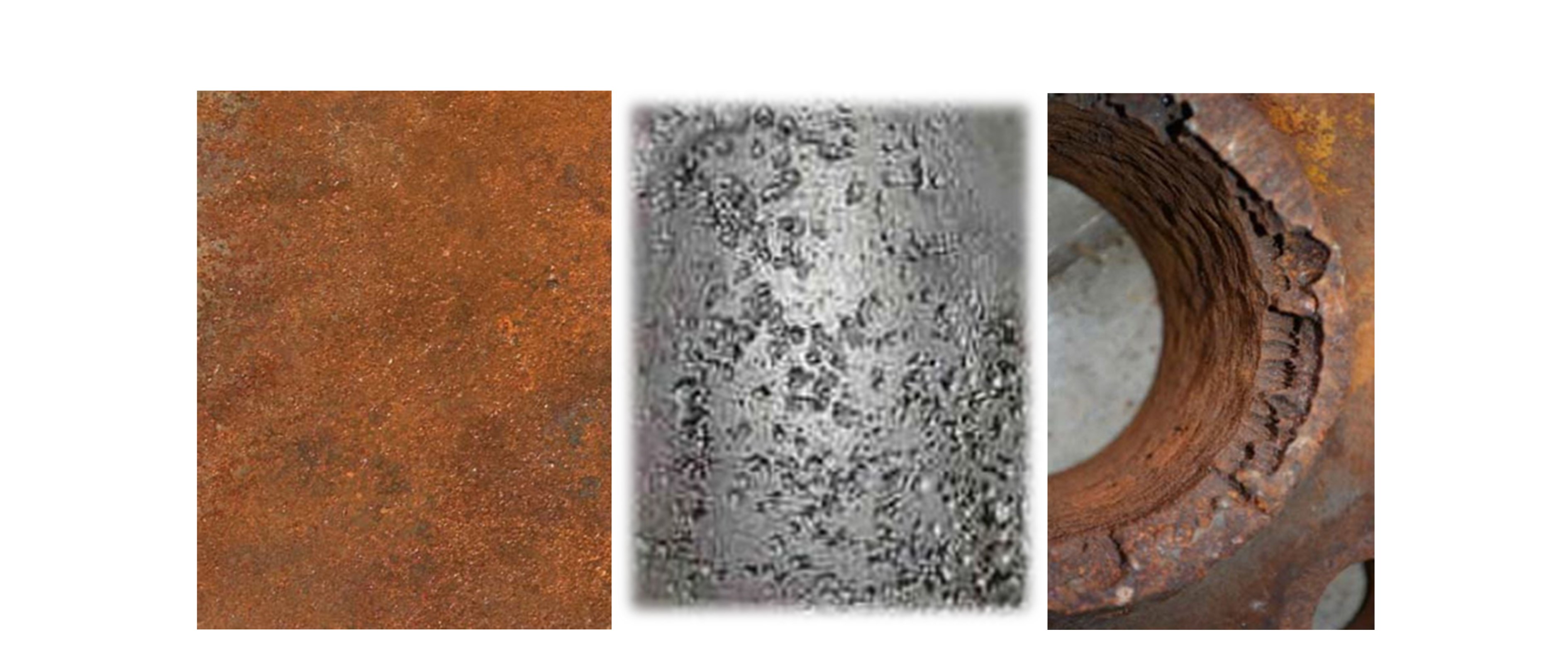
Figure 1 Different types of corrosion: (a) uniform corrosion, (b) pitting corrosion, (c) erosion corrosion (Bhardwaj, 2020.)
One of the ways to slow down the corrosion process is the use of corrosion inhibitors, which are mostly organic inhibitors. Since there are some limitations in the usage of those organic conventional corrosion inhibitors due to their toxicity, plant extracts, among other things, have been studied as so-called green corrosion inhibitors. Currently, the most researched green corrosion inhibitors are plant extracts. In order to examine their effectiveness as corrosion inhibitors, extracts of some wild plants that can be found in Croatia were tested. For the preliminary research, ten commercially available plant extracts were selected as potential carbon steel corrosion inhibitors in a simulated brine solution saturated with CO2. The aim of the conducted laboratory research was to select certain plants based on their corrosion inhibition efficiency and to examine the possibility of their application as green corrosion inhibitors in the petroleum industry. After preliminary research, lady’s mantle extract (Figure 2a) and dandelion root extract (Figure 2b) showed inhibitor efficiency higher than 90%. Therefore, those two extracts were further researched.

(a) (b)
Figure 2 Examples of (a) lady’s mantle and (b) dandelion root (Plantea, 2021.a, Plantea, 2021.b)
Efficiency of selected plant extracts as corrosion inhibitors was determined throughout electrochemical measurements (polarization measurements with Tafel extrapolation, electrochemical impedance spectroscopy), in brine with saturated CO2 in static and in flow conditions (Figure 3 and Figure 4).
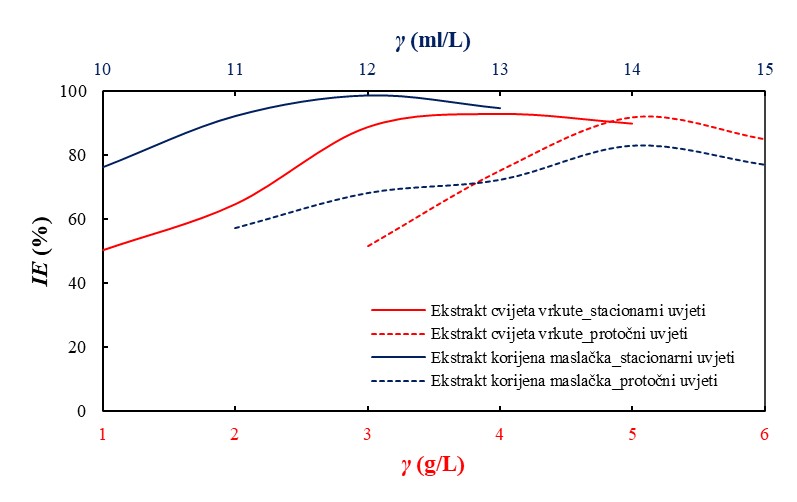
Figure 3 Comparison of Lady’s mantle extract and dandelion root extract efficiency determined from polarization measurements with Tafel extrapolation (Žbulj, 2021.)

Figure 4 Comparison of Lady’s mantle extract and dandelion root extract efficiency determined from electrochemical impedance spectroscopy (Žbulj, 2021.)
Both plant extracts showed to be effective corrosion inhibitors in both static and flow conditions. In static conditions, in comparison with lady’s mantle extract (IE= 92.68%), dandelion root extract efficiency of 98.37% was achieved. However, under flow conditions, the efficiency of dandelion root extract was not higher than 90%, while the efficiency achieved with lady’s mantle extract was almost equal to the efficiency in static conditions (IE= 91.59%). Both extracts showed to be a mixed type of corrosion inhibitor.
Reference:
Bhardwaj, A., 2020., Fundamentals of Corrosion and Corrosion Control in Oil and Gas Sectors, U: SAJI, V.S., UMOREN, S.A., ur., Corrosion Inhibitors in the Oil and Gas Industry, Weinheim, Germany, Wiley-VCH Verlag GmbH & Co. KGaA, pp 41-76
Plantea, 2021.a, Vrkuta, URL: https://www.plantea.com.hr/vrkuta/ (24.03.2021.)
Plantea, 2021.b, Maslačak, URL: https://www.plantea.com.hr/maslacak/ (24.03.2021.)
Sastri, V. S., 2011., Green Corrosion Inhibitors: Theory and Practice, Hoboken, New Jersey, John Wiley & Sons, Inc.
Žbulj, K., 2021., Extracts of selected plants as steel corrosion inhibitors in hydrocarbon production and transportation systems, doctoral thesis, Faculty of Mining, Geology and Petroleum Engineering, University of Zagreb, Zagreb, 07.12.2021.
Katarina Žbulj, mag. ing. petrol. is a postdoctoral researcher at the Department of Petroleum and gas engineering and Energy, Faculty of Mining, Geology and Petroleum Engineering. She successfully defended her doctoral dissertation on December 7th, 2021 entitled Extracts of selected plants as steel corrosion inhibitors in hydrocarbon production and transportation systems.
E-portfolio https://moodle.srce.hr/eportfolio/user/view.php?id=18039
ResearchGate Link
Google Scholar Link
CROSBI https://www.bib.irb.hr/pretraga?operators=and|%C5%BDbulj,%20Katarina%20%2833183%29|text|profile
Projects page Link