


Author: Ivor Perković, mag. geol.
Cretaceous palaeosols and terra rossa soils from the succession of the western-Istrian anticline formed in contrasting redox environment which makes them ideal for mutual comparison, as the behavior of trace elements and lanthanides is highly dependent of the redox conditions.

Slika 1. 1) geological map of Istria based on the division onto large-scale megasequences; 1 – Bathonian to lower Kimmeridgian 2 – upper Tithonian to early/late Aptian, 3 – upper Albian to upper Cenommanian/upper Santonian, 4 – foraminiferal beds (lower Eocene), 5 – fysch (middle to upper Eocene), 6 – Quaternary, 7 – normal geological boundary, 8 - erosional geological boundary, 9 - normal fault, 10 - reverse fault,11 – Western Istrian anticline, 12 – Savudrija-Buzet anticline, 13 – sampling sites of Cretaceous palaeosols, 14 – sampling sites of terra rossa.; 2) terra rossa profile in Kanfanar quarry, 3) Cretaceous palaeosol profile in Kanfanar quarry
Terra rossa soils from this area formed through pedogenesis of materials such as loess, tephra, insoluble residue, flysch and other non-carbonate material (Durn et al., 2007) in an oxidizing environment, which their red color clearly indicates. The red color in terra rossa is a consequence of rubification, the preferential formation of hematite over goethite (Boero and Schwertmann, 1989).
The Cretaceous palaeosols formed in a reducing marsh environment during the emersion which enveloped the Adriatic carbonate platform in the area od today’s Istria 120 million years ago, and it lasted between 19 to 11 million years. Their currently considered mode of formation is the deposition of volcanic material in shallow water bodies in a marshy environment, at that time covering certain areas of today’s Istria. In those marshes this material was pedogenetically altered into grey paleosols that we can find today in quarries of Istrian yellow and roadcuts in the southwestern Istria.
Five samples of both terra rossas and Cretaceous palaeosols was selected for XRF, XRD, ICP-MS, ICP-OES and Tessier sequential extraction analysis. The obtained results displayed the differences in the behavior in major and trace elements.
Cretaceous palaeosols are clay-rich, contain pyrite and have a complete absence of iron oxides when compared with terra rossa soils, which besides clay minerals also contain other silicate minerals such as quartz and feldspars together with iron oxides. Mineralogical composition is clearly mirrored in the concentrations of major oxides.
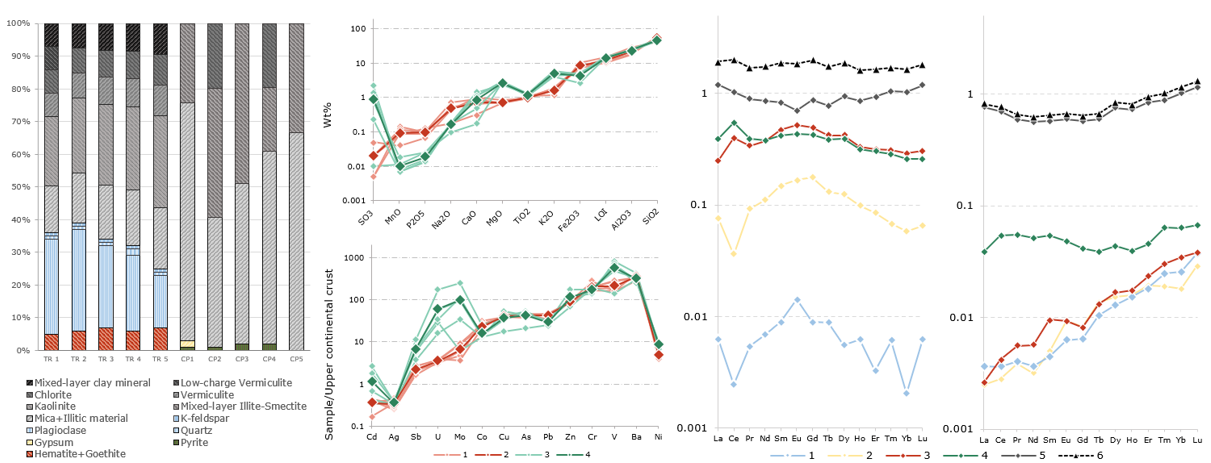
Figure 2. 1 – mineralogical composition of terra rossa (TR) and Cretaceous palaeosol (CP), 2) major oxide values (upper graph) and trace element values (lower graph) in terra rossa and Cretaceous palaeosols, 1 – individual terra rossa sample values, 2 – mean values for terra rossa, 3 – individual sample values for Cretaceous palaeosols, 4 – mean values for Cretaceous palaeosols; 3) lanthanide values in terra rossa (left graph) and Cretaceous palaeosols (right graph) in different sequential extraction steps, 1 – adsorbed fraction, 2 – carbonate-bound fraction, 3 – fraction bound to iron oxides, 4 – fraction bound to organic matter or pyrite, 5 – fraction bound in silicates, 6 – total lanthanide concentrations
The most prominent differences were those in the behavior of trace elements and lanthanides. In comparison to terra rossa soils, Cretaceous palaeosols are enriched in uranium, antimony, vanadium and molybdenum. This additionally confirms their formation in reducing redox environment, as those elements are stable in such conditions as insoluble complexes which can be retained and enriched in the sediment.
The Terra rossa has no significant enrichment in trace elements when compared to Cretaceous palaeosols, but in them characteristic trends and enrichments in lanthanides were observed which cleary indicate the formation in an oxidizing environment. Ferromanganese oxides and organic matter are commonly a sink for lanthanides in soils (Davranche et al., 2011; Laveuf et al., 2008, 2012a), which was also true for studied terra rossas. Besides the general lanthanide enrichment the enrichment of middle lanthanides (Sm, Eu and Gd) and the positive cerium anomaly was also observed. This is commonly observed as a consequence of oxidation and absorption processes related to manganese oxides (Coelho and Vidal-Torrado, 2000; Laveuf et al., 2012b; Ohta and Kawabe, 2001) and organic matter (Davranche et al., 2011).
Cretaceous paleosols are completely devoid of organic matter and iron oxides, which is a consequence of their formation in a reducing soil environment, which ultimately resulted in much smaller values of lanthanides in Cretaceous paleosols. The behavior of lanthanides are not only a proxy for redox conditions but also for general environment in which Cretaceous paleosols have formed. The enrichment of heavy lanthanides (Tb, Dy, Ho, Er, Tm, Yb and Lu) can be connected with the formation in a brackish to marine marsh environment. The elevated concentrations of other ionic species in seawater impairs the adsorption of large light lanthanide (La, Ce, Pr and Nd) ions, while the heavy lanthanides are not as affected allowing them to be more easily retained and adsorbed onto clay minerals. This is additionally confirmed with Sr/Ba values higher than 0.2, which indicates a formation in a brackish environment (Wei and Algeo, 2020).
Reference:
Boero, V. and Schwertmann, U. (1989), “Iron oxide mineralogy of terra rossa and its genetic implications”, Geoderma, Vol. 44 No. 4, available at:https://doi.org/10.1016/0016-7061(89)90039-6.
Coelho, M.R. and Vidal-Torrado, P. (2000), “Cerium (Ce) in some nodular ferricretes developed in soils of the adamantina formation”, Scientia Agricola, Vol. 57 No. 2, available at: https://doi.org/10.1590/S0103-90162000000200021.
Davranche, M., Grybos, M., Gruau, G., Pédrot, M., Dia, A. and Marsac, R. (2011), “Rare earth element patterns: A tool for identifying trace metal sources during wetland soil reduction”, Chemical Geology, Vol. 284 No. 1–2, available at:https://doi.org/10.1016/j.chemgeo.2011.02.014.
Durn, G., Aljinović, D., Crnjaković, M. and Lugović, B. (2007), “Heavy and light mineral fractions indicate polygenesis of extensive terra rossa soils in Istria, Croatia”, in Mange, M. and Wright, D. (Eds.), Heavy Minerals in Use. Developments in Sedimentology, Vol. 58, Elsevier, pp. 701–737.
Laveuf, C., Cornu, S., Guilherme, L.R.G., Guerin, A. and Juillot, F. (2012a), “The impact of redox conditions on the rare earth element signature of redoximorphic features in a soil sequence developed from limestone”, Geoderma, Elsevier B.V., Vol. 170, pp. 25–38.
Laveuf, C., Cornu, S., Guilherme, L.R.G., Guerin, A. and Juillot, F. (2012b), “The impact of redox conditions on the rare earth element signature of redoximorphic features in a soil sequence developed from limestone”, Geoderma, Elsevier B.V., Vol. 170, pp. 25–38.
Laveuf, C., Cornu, S. and Juillot, F. (2008), “Rare earth elements as tracers of pedogenetic processes”, Comptes Rendus - Geoscience, Vol. 340 No. 8, pp. 523–532.
Ohta, A. and Kawabe, I. (2001), “REE(III) adsorption onto Mn dioxide (δ-Mn02) and Fe oxyhydroxide: Ce(III) oxidation by δ-MnO2”, Geochimica et Cosmochimica Acta, Vol. 65 No. 5, pp. 695–703.
Wei, W. and Algeo, T.J. (2020), “Elemental proxies for paleosalinity analysis of ancient shales and mudrocks”, Geochimica et Cosmochimica Acta, Elsevier Ltd, Vol. 287, pp. 341–366.
Ivor Perković, mag. ing. geol. je doktorand na Zavodu za mineralogiju, petrologiju i mineralne sirovine na Rudarsko-geološko-naftnom fakultetu Sveučilišta u Zagrebu. Diplomirao je 13.7.2020. godine s diplomskim radom pod nazivom Hidrotermalne alteracije rudnog tijela Vršnik u bakarnom porfirnom ležištu Bučim, Republika Sjeverna Makedonija. Trenutno je zaposlen kao mlađi istraživač na HRZZ projektu WIANLab, u sklopu kojeg proučava boksite i druge terestričke materijale taložene u sklopu donjokimeridžke do gornjetitonske emerzije i gornjecenomanske/gornjesantnoske do donjoeocenske emerzije u sklopu slijeda zapadnoistarske antiklinale.
E-portfolio Link
ResearchGate Link
Google Scholar Link
CROSBI Link
Stranica projekta Link