CCS Master

CCS Master

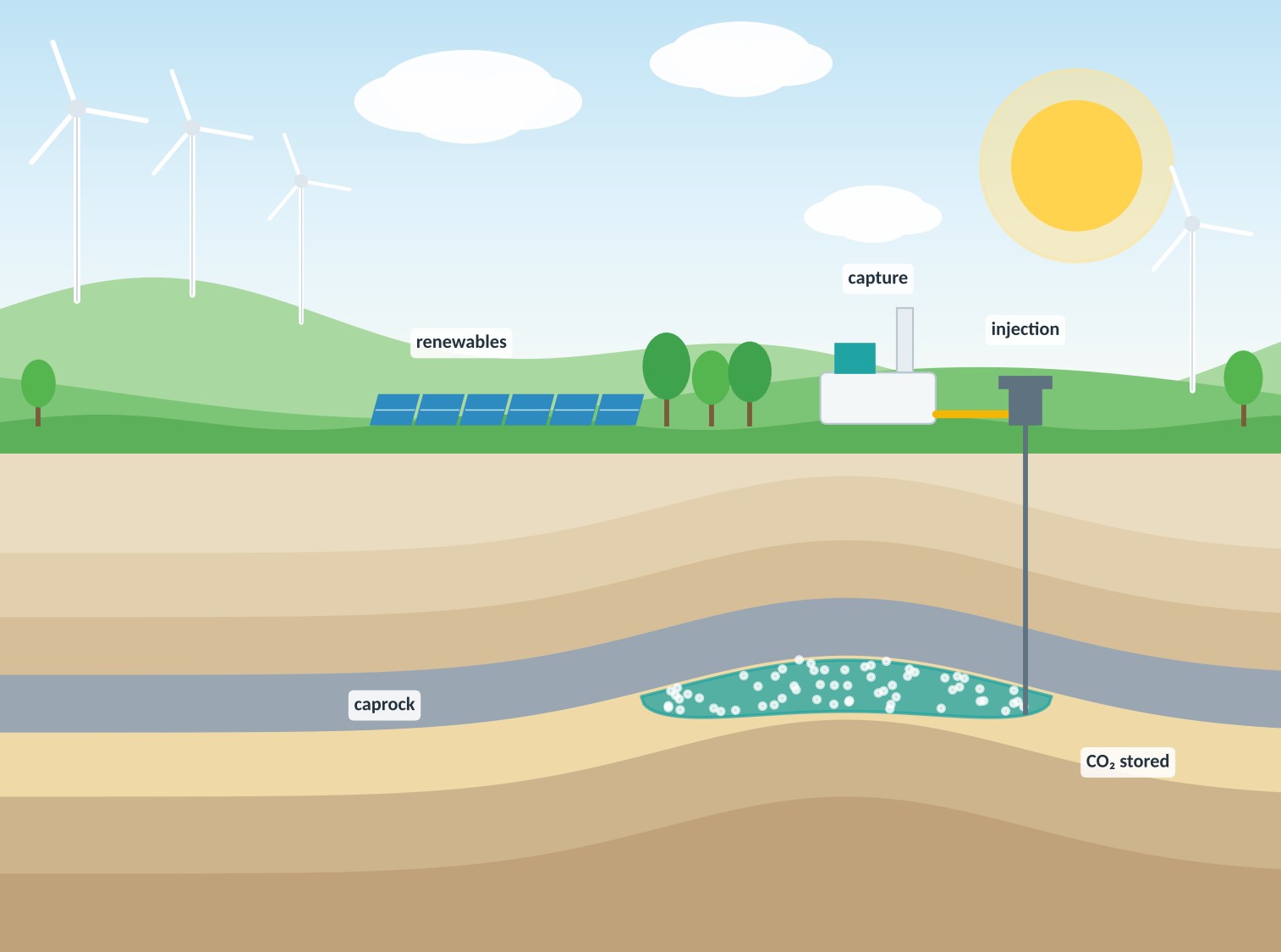
Clean-energy landscape with wind turbines and solar panels above rock layers where CO2 is stored beneath a caprock

University of Zagreb · Sapienza University of Rome

International Master in

CO₂ Geological Storage

One year. Two cities. A career in keeping carbon underground.

Your questions, answered

Apply from the publication of the official call until the end of January 2027

Supported by CO2GeoNet, the European Network of Excellence on CO₂ Geological Storage

↓  Brochure↓  Leaflet: what will you study?

The master Getting in What will I study? Time and place Studying and costs Join the list Contact

60
ECTS
2
cities
Mar–Dec
2027
€2,200
tuition
Joint
diploma

The master in one minute

QIs the master running again?

Yes. The 2026/27 edition starts in March 2027 and ends with the thesis defence in December 2027.

QWho organises it, and what do I get at the end?

60 ECTS and a joint diploma. The University of Zagreb and Sapienza University of Rome run it together, supported by CO2GeoNet, the European Network of Excellence on CO₂ Geological Storage. Your diploma carries the signatures of both rectors.

QWhat language is it taught in?

English, from the first lecture to the thesis defence.

QIs there a graduation ceremony?

Yes. Graduates receive their diplomas at the 2028 CO2GeoNet Open Forum, and CO2GeoNet covers the costs.

Getting in

QCan I apply?

Very likely. The programme is designed for graduates with a master's degree (300 ECTS in total) in Earth sciences or petroleum science and engineering, and it is open to related fields too.

QI don't have a geology degree. Can I still apply?

Yes. With a basic grounding in geoscience, you'll have a short online interview so we can make sure you'll follow the lectures comfortably. Generally, applicants who take it are accepted.

QMy degree is from outside the EU. Is that a problem?

No. The programme's Scientific-Educational Council assesses non-EU degrees for admission.

QWhat do I need to send?

Three documents, in English: a motivation letter, your CV and official evidence of your degree.

QWhen and where can I apply?

Until the end of January 2027. This call is published on this page. Can't wait? Email us and we'll add you to our list of applicants.

QWhat happens after I apply?

We confirm whether you're eligible. You then receive the payment details. If you come from outside the EU, we help as far as we can with paperwork and information on accommodation.

1
Apply
2
Short interview, if needed
3
Eligibility confirmed
4
Pay and enrol

What will I study?

QWhat will I learn?

Everything it takes to store CO₂ safely underground. Fourteen modules, taught in English by lecturers from the partner universities and CO2GeoNet research institutes, prepare you to work with every specialist on a CCS project.

The CCS chain: capture, transport, injection, storage, monitoring

00
Geoscience for engineers
The geology a CCS engineer needs: rocks, sedimentary basins, structures and the subsurface settings that can hold CO₂ safely.
01
Introduction to CO₂ geological storage: social aspect
The whole storage chain at a glance, its role in tackling climate change, and how the public and stakeholders see the technology.
02
CO₂ capture and transport; present-day industrial use of CO₂
How CO₂ is captured from industrial sources, the pros and cons of each technology, how it is transported, and where capture runs today.
03
Introduction to exploration geophysics
Seismic acquisition, processing and interpretation for site characterisation: identify traps and build 3D geological models in hands-on software exercises.
04
Drilling and wells
Rigs, drilling muds, well trajectories, well control, testing and completions, with practical design calculations for mud weights and casing.
05
Introduction to reservoir engineering
Multiphase flow in porous rock, PVT behaviour of CO₂-rich fluids, injectivity and fracture pressure, material balance and decline-curve analysis.
06
Storage site selection and capacity estimates
From basin screening to site characterisation: estimate capacity in saline aquifers, depleted fields, coal seams and salt caverns; judge reservoir and caprock quality.
07
Numerical modelling of CO₂ storage
Build static models and simulate CO₂ injection: migration, pressure build-up, dissolution and trapping, grid choice, upscaling and uncertainty.
08
Advanced CCUS: EOR and CO₂-plume geothermal UPDATED FOR 2027
CO₂ as a working fluid: enhanced oil and gas recovery, CO₂-plume geothermal energy, miscibility and PVT simulation, ending with your own injection project.
09
Storage risks
Risk assessment across a project's life: hazards, possible leakage pathways, environmental impacts, and the mitigation and remediation plans that keep storage safe.
10
Geophysical monitoring
Seismic, electrical and electromagnetic methods to characterise and monitor storage sites: survey design, field acquisition, processing and inversion, with field work.
11
Geochemical monitoring
Soil-gas, groundwater, atmospheric and marine techniques to verify storage, detect and quantify leaks and check remediation, with hands-on field exercises.
12
Geomechanical aspects and passive seismics
How injection changes stresses in reservoir and caprock, fault stability and induced seismicity, and how passive seismic monitoring picks up small events.
13
Economic and regulatory aspects of CCS and cross-cutting issues
Economics and regulation of CCS, plus CO₂ use options: mineral carbonation, storage in basalts, bio-CCS and negative emissions, industrial clusters.

The same subsurface skills are used in geothermal energy and underground energy storage.

Time and place
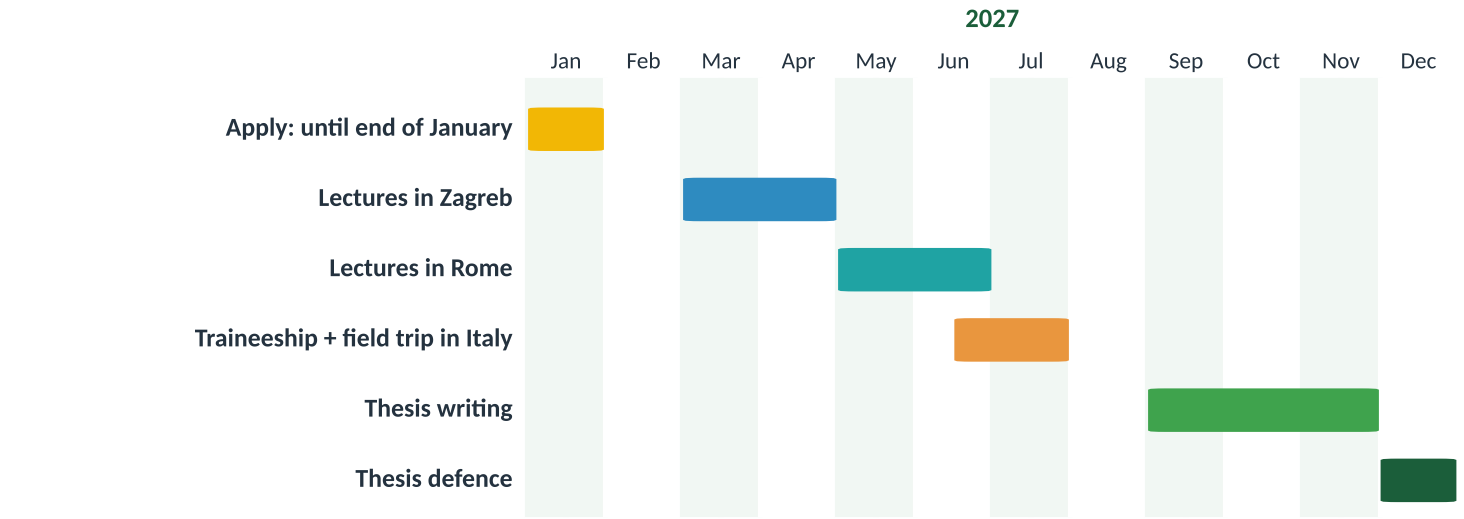
2027 timeline: apply until end of January; lectures in Zagreb March to April; lectures in Rome May to June; traineeship and field trip in Italy late June to July; thesis September to November; defence December

QWhen does it start, and how is the year organised?

In March 2027. Teaching runs in blocks of one or two weeks, first in Zagreb, then in Rome, followed by a traineeship and a mandatory field trip in Italy. The thesis follows in autumn, with an in-person defence in December.

Studying and costs

QCan I follow the course online?

Partly. While courses may be held online, the field work in Italy (and the thesis defence) need you there in person.

QHow much does it cost?

€2,200 tuition. Travel, food and accommodation in Zagreb and Rome are not included.

QHow and when do I pay?

After we confirm you're eligible, by bank transfer to the Faculty account, quoting the reference from your confirmation.

Join the list of applicants

Write to us from this page

Click a button below: a message to us opens with the recipient, subject and questions already written. Fill in the lines, attach your motivation letter, CV and evidence of your degree (in English) and press Send. Applications are open until the end of January 2027.

Your email opens with these lines ready to fill in:

Full name:
Email:
Degree (title, total ECTS, university, country):
Background in geoscience:
Why this master (2-3 sentences):
Attached: motivation letter, CV, evidence of my degree (in English)

This email address is being protected from spambots. You need JavaScript enabled to view it.GmailOutlook.com

Nothing opens? Write to This email address is being protected from spambots. You need JavaScript enabled to view it. and include the lines above. Nothing is stored on this page: the message goes from your own email account straight to the programme coordinator.

Still have a question? Write to us.

Zagreb
Domagoj Vulin
This email address is being protected from spambots. You need JavaScript enabled to view it.
Rome
Sabina Bigi
This email address is being protected from spambots. You need JavaScript enabled to view it.

↓  Brochure↓  Leaflet: what will you study?

CO₂ Geological Storage · International Master · 2027 edition